
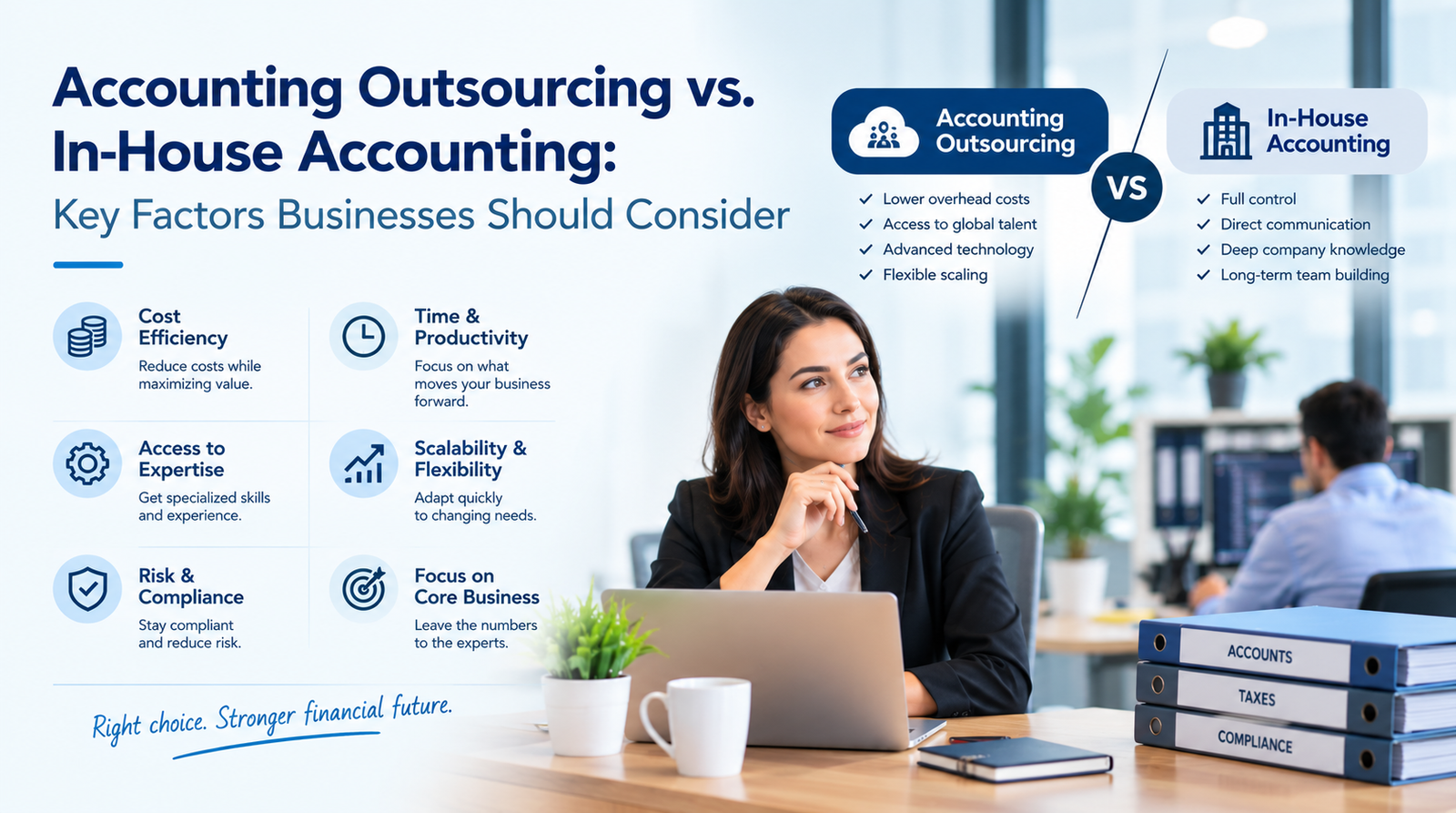
As a business grows, so does its accounting workload. More transactions, payroll, compliance and reporting can make in-house accounting expensive and add pressure to internal teams.
Accounting outsourcing offers a flexible alternative by providing professional support without the cost of expanding an internal finance team. Through outsourcing services, businesses can manage accounting tasks more efficiently while accessing the expertise and support they need as they grow.
What Is the Difference Between Outsourced and In-House Accounting?
Businesses looking to reduce accounting costs and workload compare in-house accounting with outsourcing before choosing a suitable model. The key differences come down to how accounting is managed, the resources required and how easily support scales with the business.
| Factor | In-House Accounting | Outsourced Accounting |
| Accounting Team | Employees hired directly by the business | External accounting professionals |
| Cost | Salaries, benefits, software and training | Service fees based on requirements |
| Expertise | Depends on the internal team | Access to broader accounting expertise |
| Scalability | Additional hiring may be required | Support adjusts with business needs |
| Control | Direct day-to-day oversight | Managed through agreed processes |
| Workload | Handled internally | Shared with an external provider |
7 Factors to Consider When Choosing Between Outsourcing and In-House Accounting
Choosing between in-house and outsourced accounting depends on more than the cost of hiring an accountant. Businesses also need to consider the expertise they require, their current workload, growth plans and how much control they want over financial operations. The following factors help make the comparison clearer.
1. Total cost of accounting support
In-house accounting involves more than an employee’s salary. Recruitment, benefits, software, training and leave coverage all add to the overall cost. Outsourcing replaces many of these expenses with a service fee based on the support your business needs.
2. Access to accounting expertise
An in-house accountant’s expertise is limited to the skills available within your team. Outsourcing gives businesses access to professionals with experience across areas such as bookkeeping, payroll, reporting and financial management.
3. Ability to scale with your business
Growing transaction volumes often increase the pressure on an internal accounting team. Businesses may need to hire additional staff to keep up. Outsourced accounting provides a more flexible way to adjust support as financial requirements change.
4. Control and communication
An in-house team provides direct oversight and daily access to accounting staff. With outsourcing, businesses rely on agreed processes, communication channels and reporting schedules to maintain visibility over their finances.
5. Technology and accounting systems
Managing accounting internally also means investing in suitable software, integrations and ongoing system support. An outsourced provider often brings established accounting systems and technical knowledge, reducing the need for businesses to manage these resources alone.
6. Workload and business owner time
Accounting tasks take valuable time away from owners and employees when handled internally without enough resources. Outsourcing routine financial work helps reduce this administrative burden and gives internal teams more time for core business activities.
7. Data security and compliance
Financial information needs strong controls regardless of the accounting model. Businesses should assess access permissions, data handling, confidentiality measures and compliance practices when managing accounts internally or selecting an outsourced provider.
When To Pick In-House Accounting?
In-house accounting suits businesses that need close control over their financial operations and prefer dedicated internal support.
- You need a dedicated accountant available for daily financial tasks.
- Your business handles a high and consistent volume of transactions.
- Your accounting needs require frequent internal collaboration.
- You want direct oversight of accounting processes and financial records.
- Your business has the budget to cover salaries, benefits and employee-related costs.
- Your finance requirements are stable enough to support a permanent internal role.
When To Pick Accounting Outsourcing?
Accounting outsourcing suits businesses that need flexible support without building a larger in-house finance team.
- You want to reduce the costs of maintaining an internal accounting team.
- Your accounting workload changes as business activity fluctuates.
- You need access to a wider range of accounting expertise.
- Your business is growing and requires growing financial support.
- You want to reduce the administrative burden on internal teams.
- You need professional accounting support without hiring additional employees.
Questions to Ask Before Choosing an Accounting Model
Before choosing between in-house and outsourced accounting, businesses should assess their current resources, financial workload and future needs. Ask these questions to make the decision more practical:
- What is the total cost of maintaining an in-house accounting function?
- How much accounting work does the business handle each month?
- Do we need one accountant or support across multiple accounting functions?
- How much time does our team spend managing routine accounting tasks?
- Will our accounting workload increase as the business grows?
- How much control do we need over daily accounting operations?
- What level of reporting and financial expertise does the business require?
Build the Right Accounting Support for Your Business
Whether you manage accounting internally or outsource it, the right support should keep your finances organised without adding unnecessary pressure to your team. When accounting workloads become difficult to manage, StedyDesk provides flexible financial support specific to your business needs.
From bookkeeping and accounting to tax preparation and financial advisory, StedyDesk helps businesses manage their financial backend with scalable support and professional expertise.
Frequently Asked Questions (FAQs)
1. Is outsourcing accounting cheaper than hiring an in-house accountant?
Outsourcing reduces employment-related overheads like salaries, benefits, recruitment and training. The actual cost depends on the services required and the provider’s pricing structure.
2. When should a growing business consider outsourcing its accounting?
Businesses often consider outsourcing when accounting workloads increase, internal staff becomes stretched or hiring another finance employee becomes difficult to justify.
3. Does outsourcing accounting reduce a business owner’s control over finances?
No. Businesses gain visibility through agreed reporting, approval processes and communication systems. The level of involvement depends on the service arrangement.
4. Can a business outsource accounting while keeping an in-house accountant?
Yes. A business can keep core accounting responsibilities in-house while outsourcing specific tasks such as bookkeeping, payroll, reporting or tax preparation.